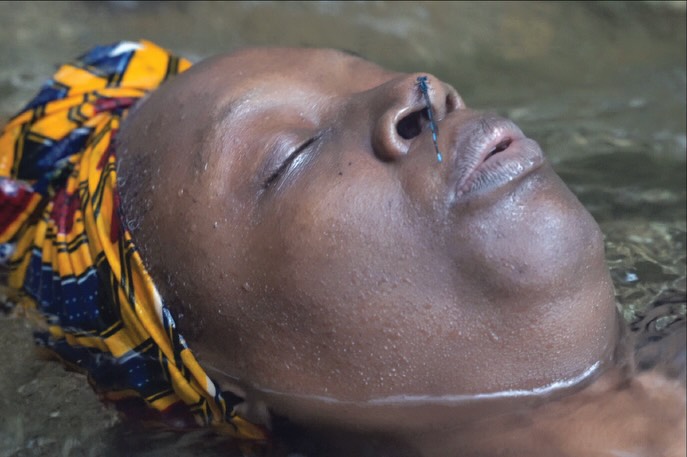
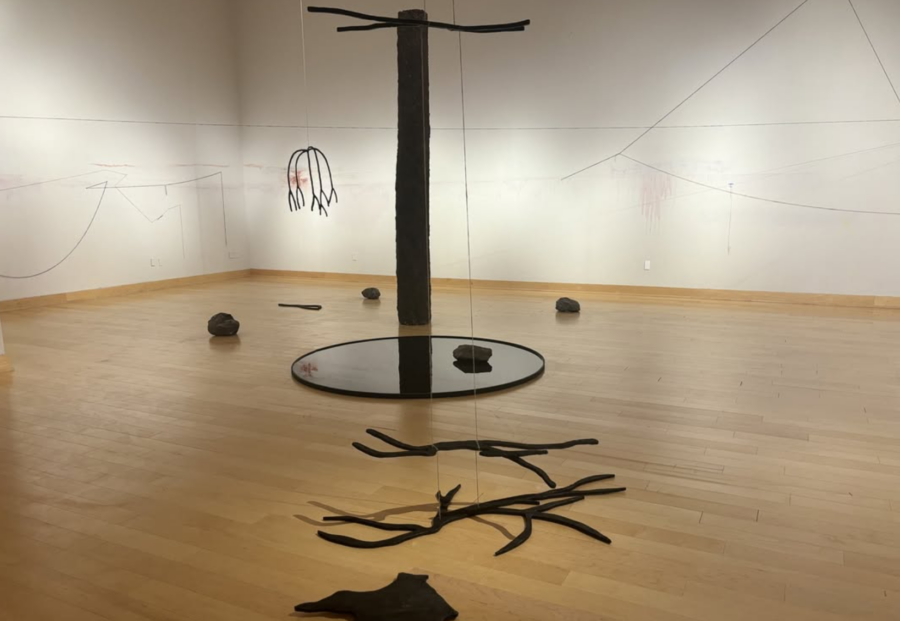
“Nuestras escuchas” traces the enduring legacy of colonialism in the Caribbean context and explores water as a living archive that preserves movements, displacements, and memories. Far from being conceived as a boundary, the sea is presented as a space of exchange where human and non-human experiences converge. Biabiany’s work establishes a dialogue between local knowledge and poetic imagination to explore the deep connections between bodies, landscapes, and species such as sperm whales that share the same living space. Through images, sounds, and narratives surrounding the ocean, the artist invites us to recognize the sea as a sensitive territory, a bearer of ecological, historical, and emotional memories. Curator: Virginia Roy Luzarraga.
Minia Biabiany’s new video work Nuestras escuchas, realized in collaboration with Murielle Biabiany, Chloé Cramer, Nouma de Lacroix Cobral and Célia Poulot, is commissioned by the Han Nefkens Foundation; MACBA, Barcelona; MUAC, UNAM, Mexico City and The Bass Miami Beach.
Minia Biabiany, Nuestras escuchas, 2026. Video still. Courtesy the artist and Galerie Imane Farès.
Inspirée de la trajectoire de l’écrivaine Maryse Condé, cette exposition collective croise les regards de vingt-huit artistes contemporains, caribéens et africains, autour de toutes les relations qui nourrissent le devenir de la Caraïbe-Monde dans une période traversée par la violence des imaginaires coloniaux.
How do we imagine living environments in a world facing planetary shifts and ecological challenges? Magical Realism: Imagining Natural Dis/order brings together over thirty artists including Minia Biabiany at WIELS and beyond, offering new ideas and perspectives on the relationship with our planet.
The exhibition is an invitation to move away from systems driven by endless growth and resource extraction, encouraging a deeper connection with the many entanglements that shape our biosphere.
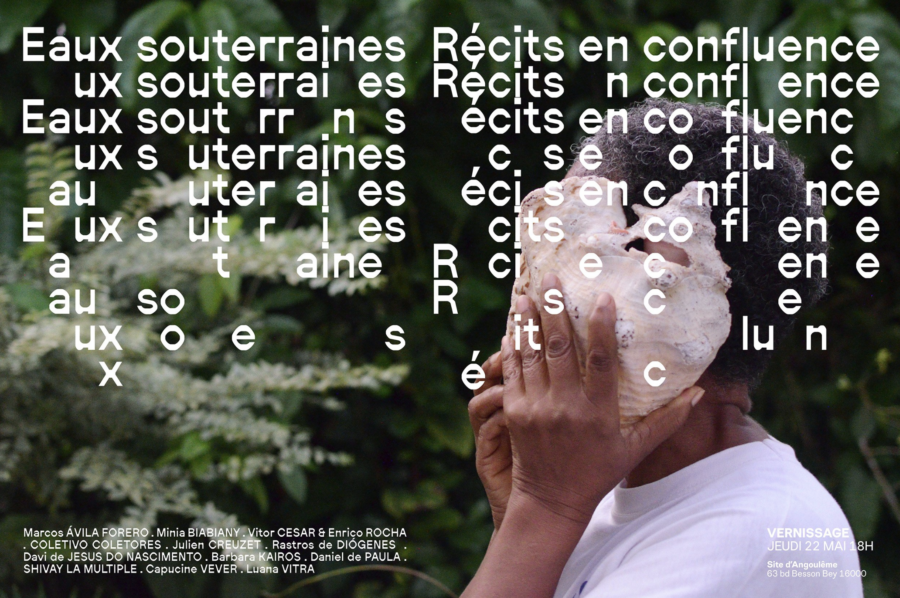
Conçue comme un dialogue imaginaire entre le fleuve Charente et les rivières de São Paulo comme le Tietê, qui parcourent respectivement les territoires du Frac Poitou-Charentes (Angoulême) et de l’Instituto Tomie Ohtake (São Paulo) où elle sera successivement présentée, l’exposition rassemble les oeuvres de douze artistes français et brésiliens.
À l’ère du changement climatique, les oeuvres présentées explorent les thèmes de la pénurie d’eau, de la relation de l’eau avec les histoires coloniales et extractivistes, des questions d’infrastructure et des futurs possibles. « Eaux souterraines : récits en confluence » donne à voir des pratiques artistiques qui reconnaissent les cours d’eau comme des êtres vivants dotés de droits intrinsèques, mais aussi en tant que témoins ancestraux, participants de l’histoire humaine, porteurs de transformations et de rencontres.