Minia Biabiany
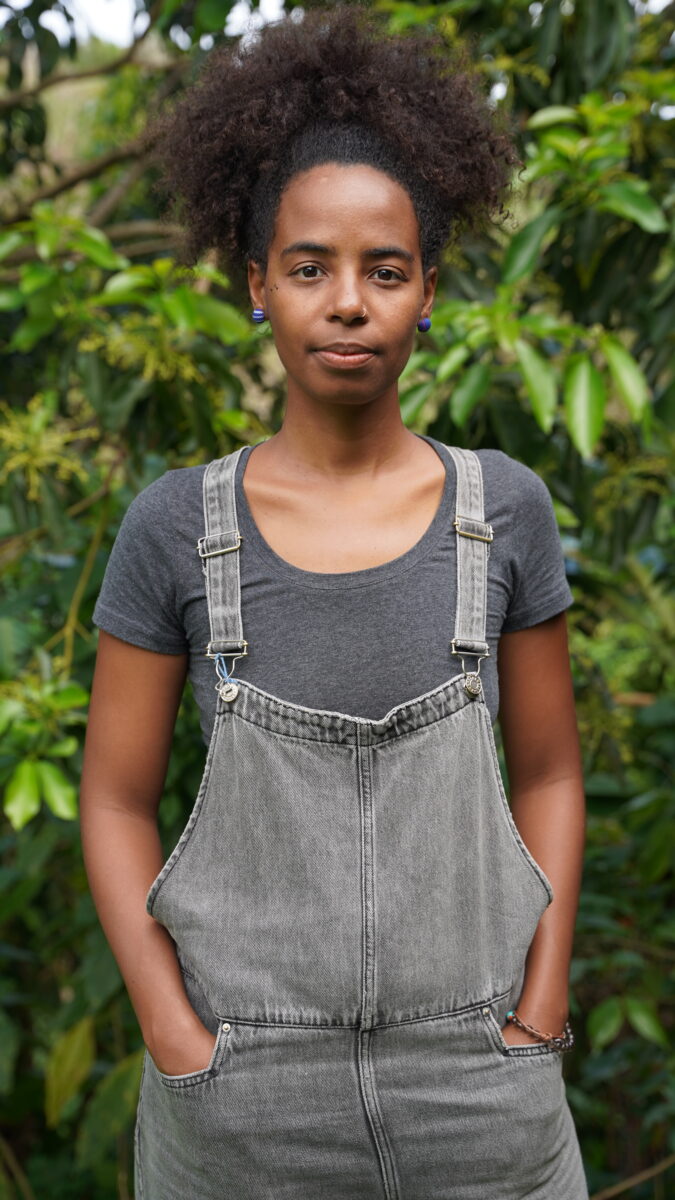
Minia Biabiany’s work explores Caribbean narratives, decolonization processes, and the connections between language, body, and territory. Through installations, videos, and pedagogical projects, she examines memory and colonial legacy, using organic materials and minimal gestures. Her work is rooted in a reflection on perception and displacement, in which language and the body become vehicles for transmission. Drawing on poetry and sensorial experience, she creates spaces where history and ancestral knowledge engage in dialogue with the present.
Her work has been the subject of solo exhibitions including nuestras escuchas (MUAC, Mexico City, 2026); le ciel aux yeux-racines (Galerie Imane Farès, Paris, 2025); dlo a rasin (water from the roots) (Duke Hall Gallery of Fine Art, Harrisonburg, USA, 2024); soplo (MAC Panama, Panama City, 2023); pluie sur mer (Le Grand Café – centre d’art contemporain, Saint-Nazaire, 2022); difé (Palais de Tokyo, Paris, 2022); J’ai tué le papillon dans mon oreille / I killed the butterfly in my ear, (Kunstverein Freiburg, Freiburg, 2021); L’orage aux yeux racines (Les Tanneries, Amilly, 2021); j’ai tué le papillon dans mon oreille (Le Magasin des horizons, Grenoble, 2020); one month after being known in that island (Kulturstiftung Basel H. Geiger, Basel, 2020); musa nuit (La Verrière – Fondation d’entreprise Hermès, Brussels, 2020); le jour des esprits est notre nuit (CRAC Alsace, Altkirch, 2019); and spelling (SIGNAL – Center for Contemporary Art, Malmö, 2016).
It has also been presented in numerous group exhibitions, notably at the Harvard Alain Locke Gallery of African and African American Art (Cambridge, USA, 2026), CAPC musée d’art contemporain de Bordeaux (2026), the 36th São Paulo Biennial (2025), the Mercosur Biennial (Porto Alegre, 2025), WIELS (Brussels, 2025), Fundación Jumex (Mexico City, 2025), the Instituto Tomie Ohtake (São Paulo, 2025), Musarth (Guadeloupe, 2025), KunstMeran (Merano, 2025), Frac Poitou-Charentes (Angoulême, 2025), the Bienal Paiz (Antigua Guatemala, 2023), TEOR/éTica (San José, 2023), the Anozero Coimbra Biennial (2022), Manifesta 13 (Marseille, 2020), the Corcoran (Washington, D.C., USA, 2019), the 10th Berlin Biennale (2018), Centro León (Santiago de los Caballeros, 2018), Mémorial ACTe (Pointe-à-Pitre, 2017), Witte de With Center for Contemporary Art (Rotterdam, 2016), and Cráter Invertido (Mexico City, 2016).
In 2016, she initiated the collective project Semillero Caribe in Mexico City and continues her pedagogical research through Doukou, an experimental platform exploring the concepts of Caribbean authors through the body and sensory experience. She was awarded the Sciences Po Contemporary Art Prize in 2019 and was nominated for the Future Generation Art Prize in 2021. In 2024, she received the Moving Image Commission of the Han Nefkens Foundation, in partnership with MACBA (Barcelona), MUAC (Mexico City), and The Bass (Miami Beach).
Her works are held in numerous collections, notably those of MAC Martinique, the Frac Pays de la Loire, Grand Large – Hauts-de-France, Bretagne, Nouvelle-Aquitaine MÉCA, Île-de-France, Lorraine and Guadeloupe, Centro León (Santiago de los Caballeros), the Institut d’art contemporain Villeurbanne/Rhône-Alpes, Kadist (San Francisco), the Centre national des arts plastiques (Paris), the Harvey B. Gantt Center for African-American Arts + Culture (Charlotte), MUAC (Mexico City), MACBA (Barcelona), and The Bass (Miami Beach).