
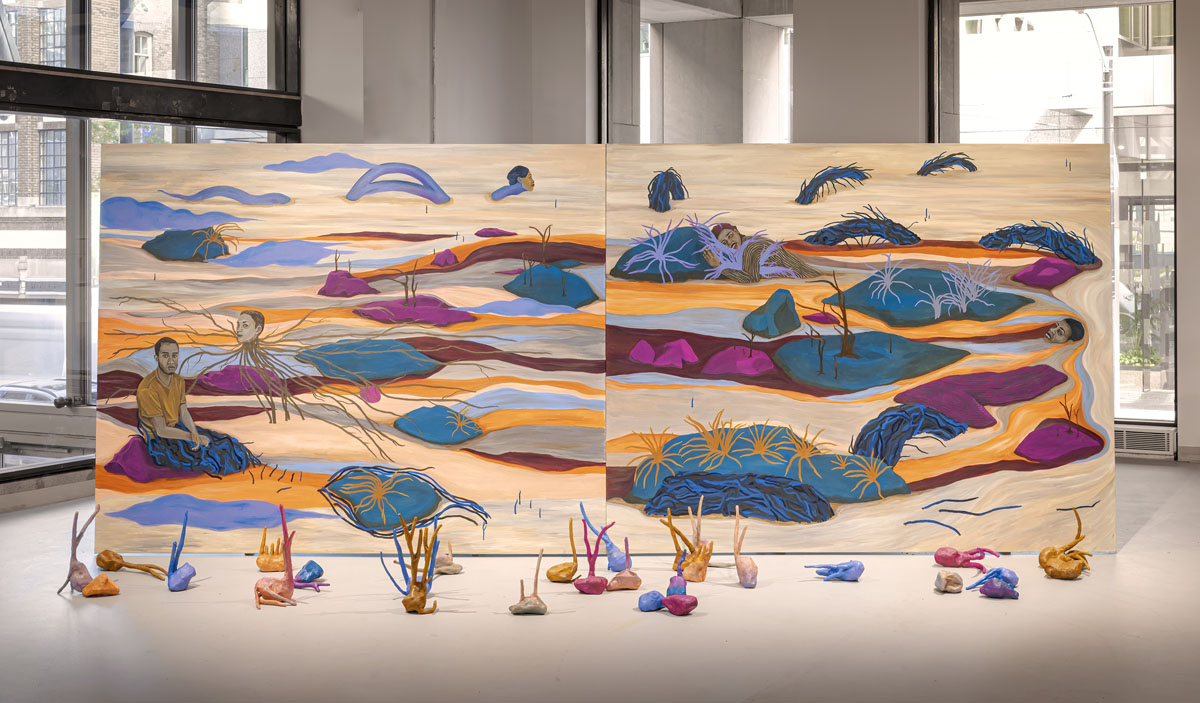
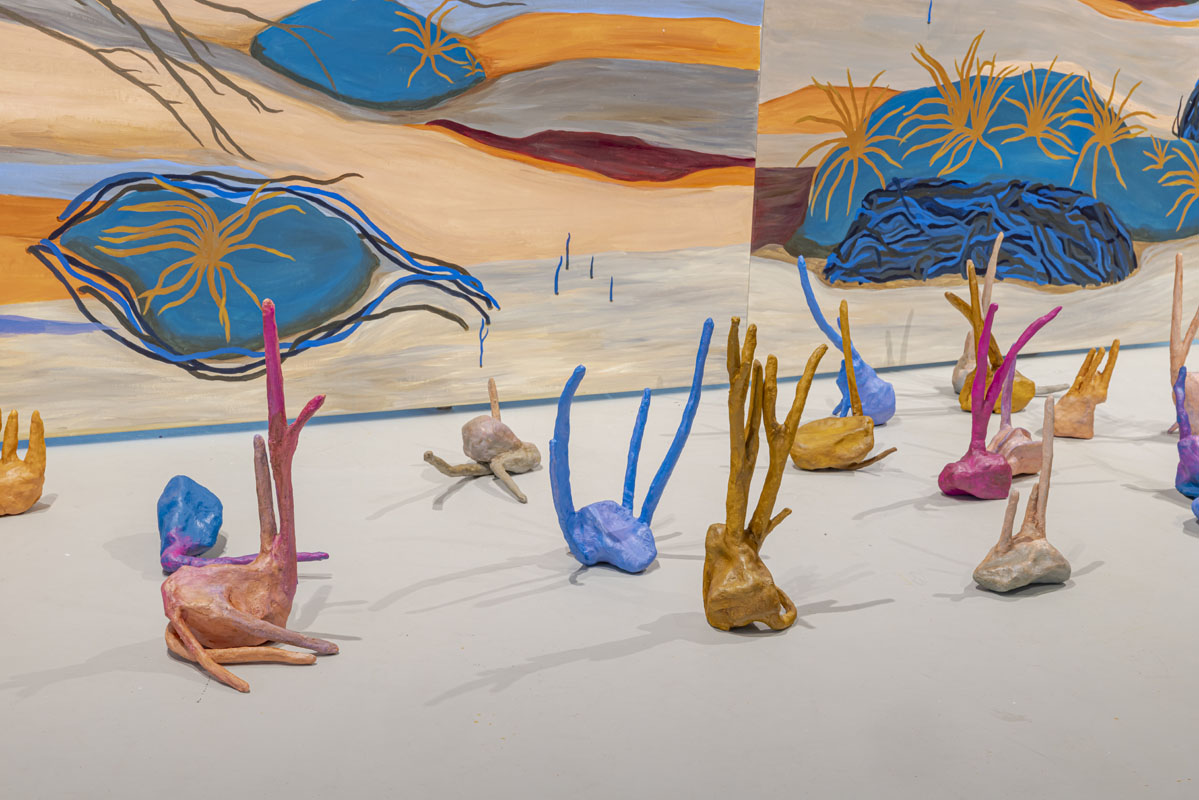
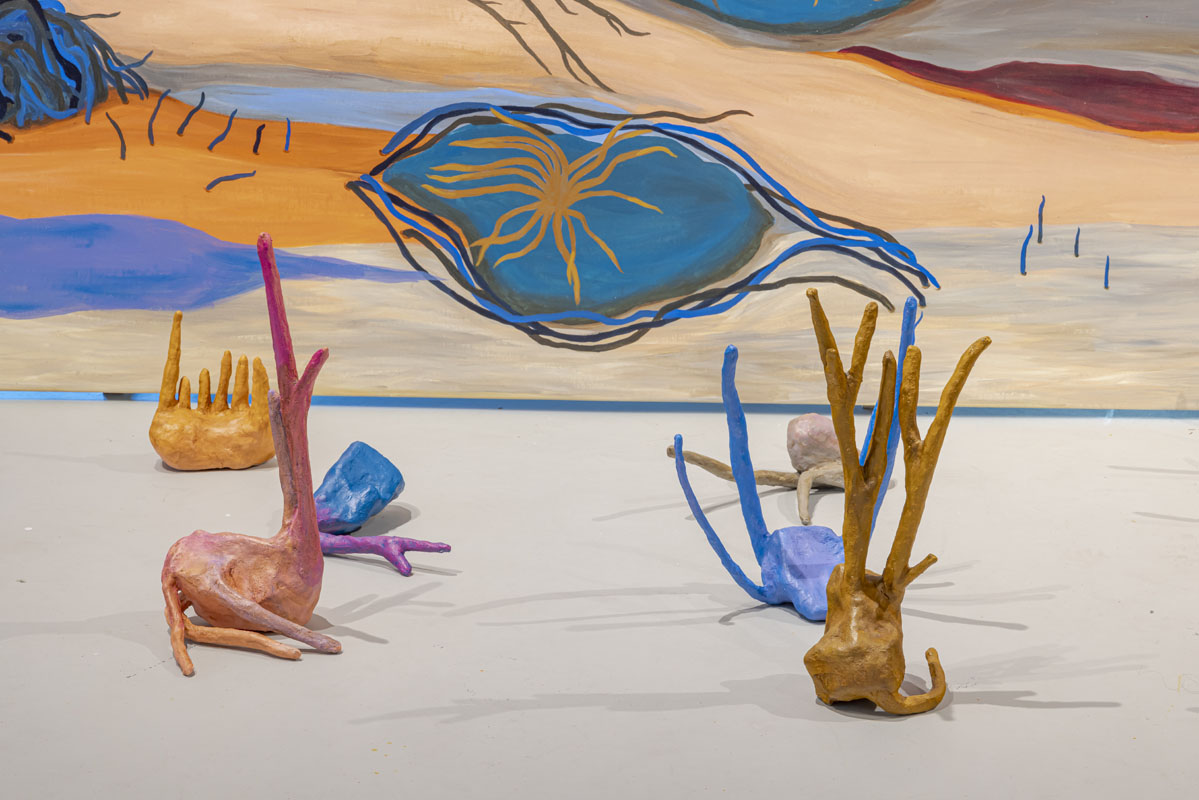
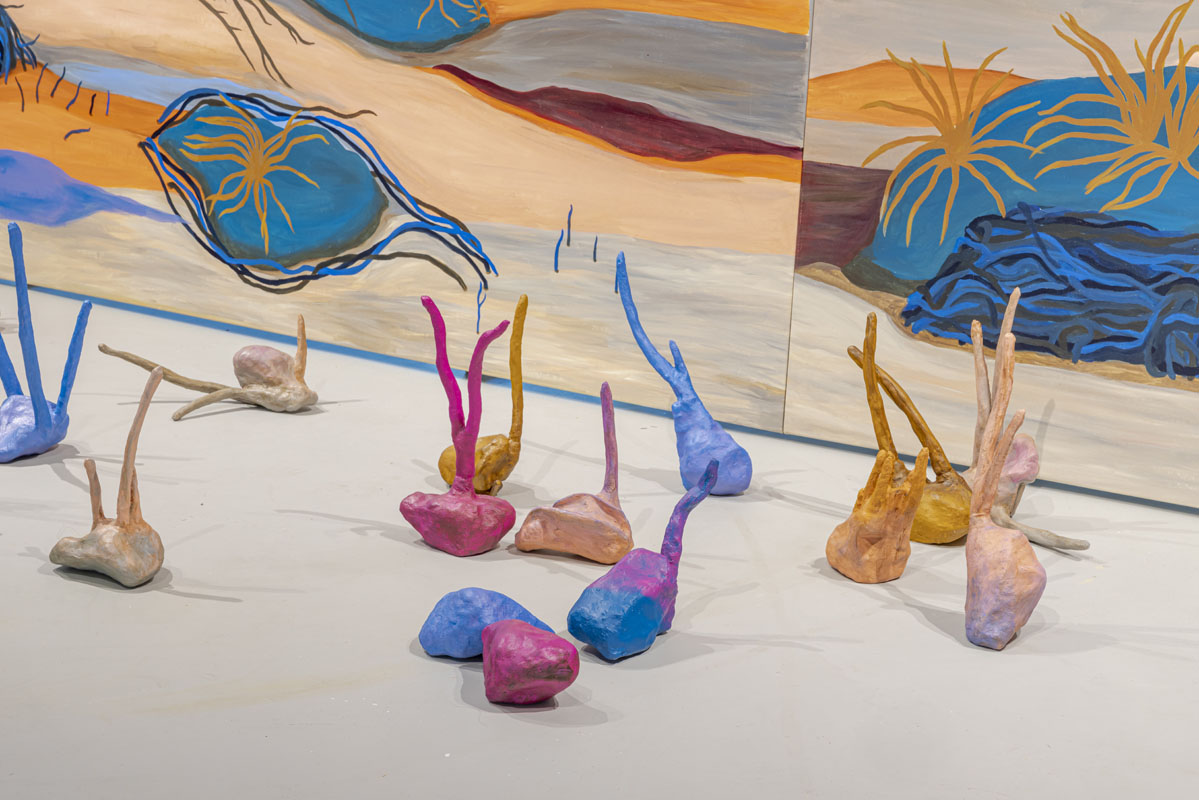
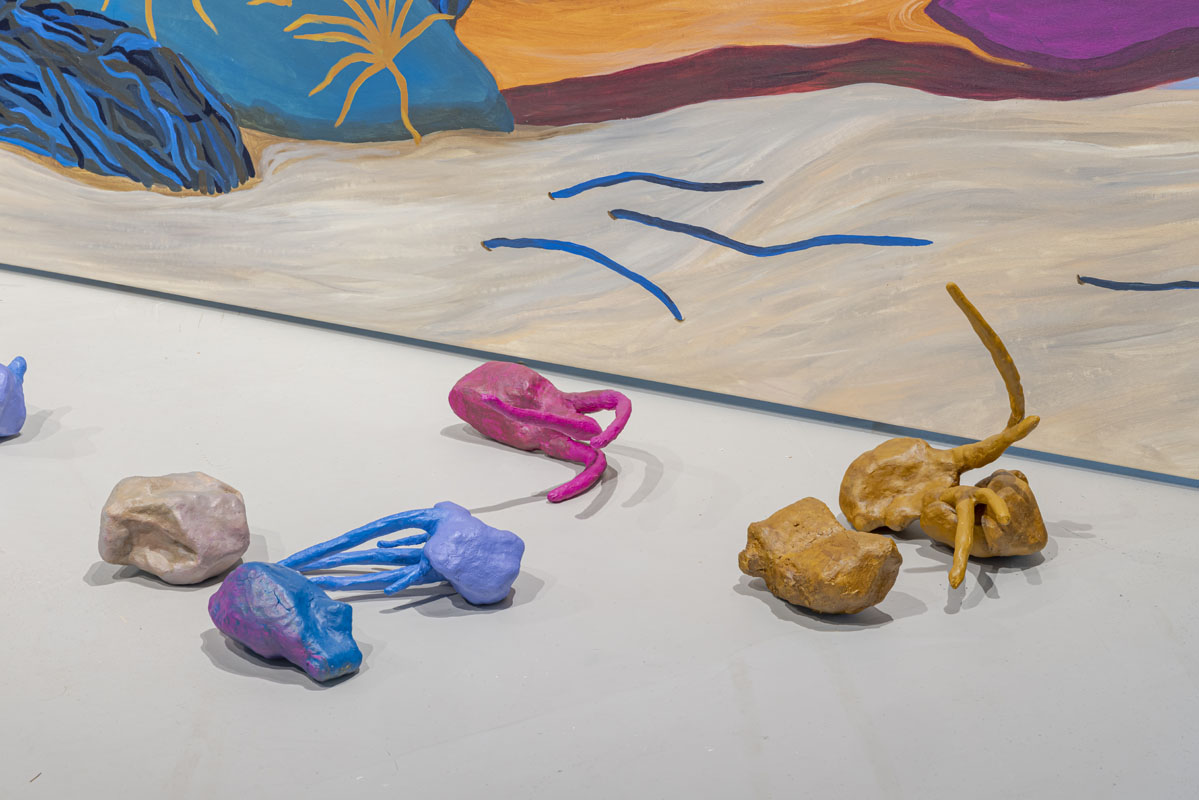
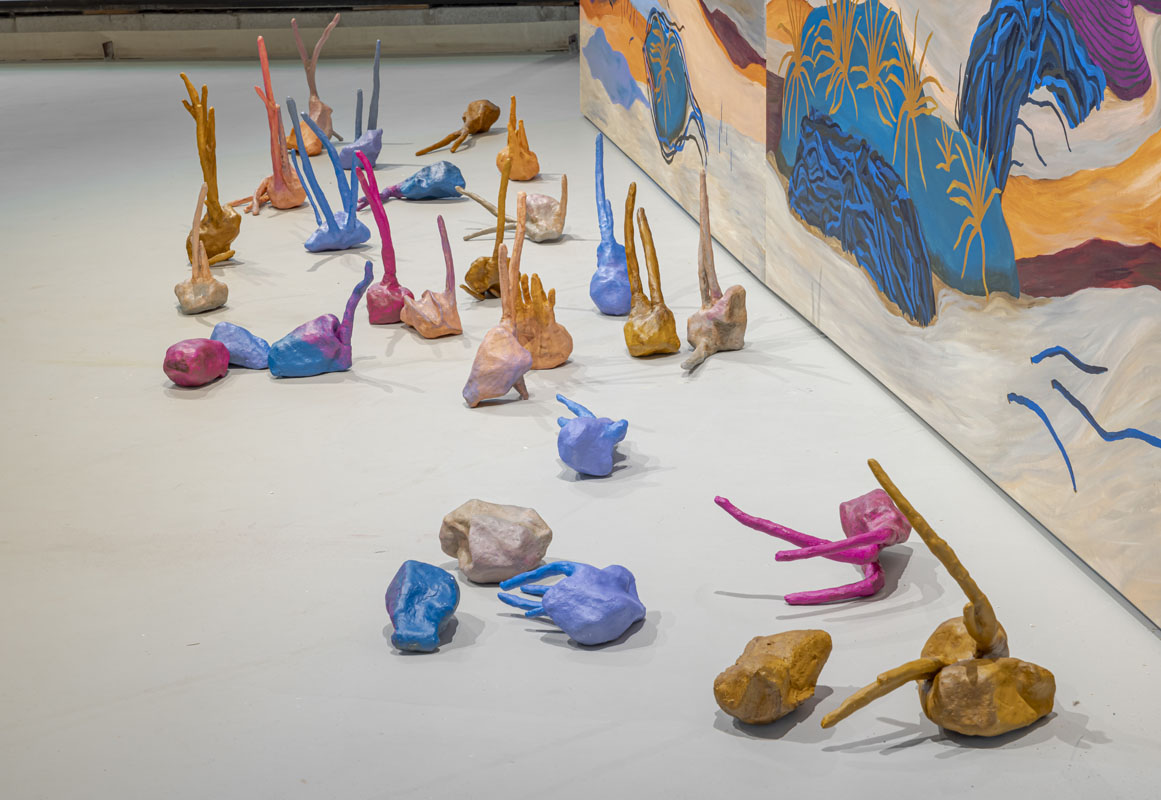
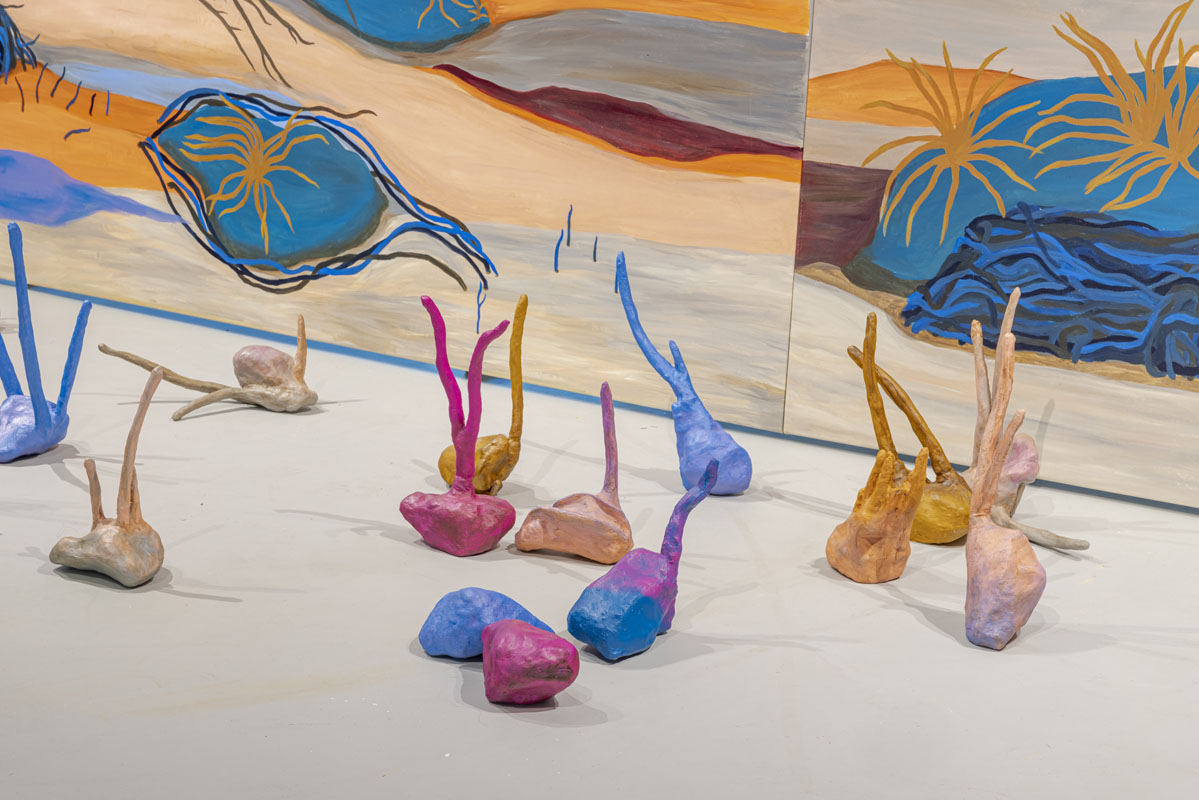
All Islands Touch (2024) is a newly commissioned installation consisting of a large-scale painting and several heart-shaped paper-mâché sculptures arranged around it. When placed on the ground, the painting and sculptures create a personal map that depicts the relationship between the body and the land, presenting a landscape that visitors can walk around. The artworks address the impact of human disruption on nature and the devastation of ecosystems. Tessa drew inspiration from a traditional Haitian lullaby she came across after moving to the Netherlands in 2020.
Tessa Mars’s work focuses on gender, landscape, Haitian history, and the African Caribbean diaspora. Through painting and sculpture, the artist challenges colonial narratives and traditional ideas of identity and geography, embracing alternative forms of collective belonging. Many of the characters in her work emerge from the soil, symbolizing regeneration, survival, and the transmission of knowledge.
Commissioned by the Toronto Biennial of Art and made possible with the generous support of the Women Leading Initiative. The third edition of the Toronto Biennial of Art, Precarious Joys, has been co-curated by Dominique Fontaine and Miguel A. López.
« All Islands Touch is, for me, a map and a story. I felt compelled, in my recent work, to engage with the idea of a spiritual space of migration as I wrestle to understand my own experience of leaving Haiti and that of various members of my family. How do I talk about our complex relationships to land, to movement, to time, into each other? How do I tell about constant change, ever-shifting landscapes and situations? How do I bring forward the bonds which take such care to maintain despite the separation?
All Islands Touch envisions our journeys as a malleable territory, where distances collapse, all lands, waters and time exist in the same piece of the canvas, and beyond, in the space all around it. People and beings are linked together by patterns, colour and metaphorical roots on the surface, but also below it, as we move together, but apart. Everything moves around us and with us.
Many Haitian people are having similar experiences of migration. Many people all over the world are, although the circumstances and conditions of our travel vary greatly. I believe some core elements in this experience are shared beyond the point of origin and the eventual destination. I’m curious to find what these elements might be and, in the meantime, find solace in thinking that if all islands touch, all continents, all land, then we are also always touching, and one day we will see each other again. »
— Tessa Mars